Signal
137Akshay kumar
Verified with LinkedIn and X. A real person owns this profile. Request to connect to talk in person, or chat with their second brain.Project Manager across AI/ML product delivery, AI search visibility, and product
Delhi, Delhi, India · Product Space · Cognerd.ai · National Informatics Centre
3 people talked to Akshay's brain
Akshay's brain
Updated 12 hr agolinked topicsbigger dot = more linkscolour = topics that link together
- Jensen Huang Return To Nvidia
- Ai Wedding Planning Orchestration
- Ai S Impact On Work And Judgment
- Generative Ai Product Management
- Project Management Challenges
- Improving Search And Discovery
- Ai Powered Personalized Travel Discovery
- Ai Tools For Ai Product Manager
- Jobs To Be Done Framing
- Metrics And Experimentation
- Personal Productivity Dashboard
- Prioritizing Right Problems
- Reconciliation Trust Issue
- Search Process
- Morning Alarm Humor
- Human Control In Agentic Ai
- Curiosity And Learning
- Learn Before Building
- Sign In Claude
- Ai Tool Requirements
- Anniversary Celebration
- Skill Based Hiring
- Ai Tools For Product Managers
- Ticket Readiness
- Hiring Product Manager
- Engagement Vs Value
- Idea Limitation
- Inclusive Product Design
- Ai Tools Discussion
- Context Driven Ai Usage
- Demo To Product
- Ai Model Launch Excitement
- Ai Usage
- Awards And Milestones
- Events And Talks
- Linkedin Profile
Talk to Akshay about
Akshay kumar @akshay · Nov 24
Remarkable welcome back of Jensen Huang to NVIDIA 🔥Akshay kumar @akshay · Nov 18
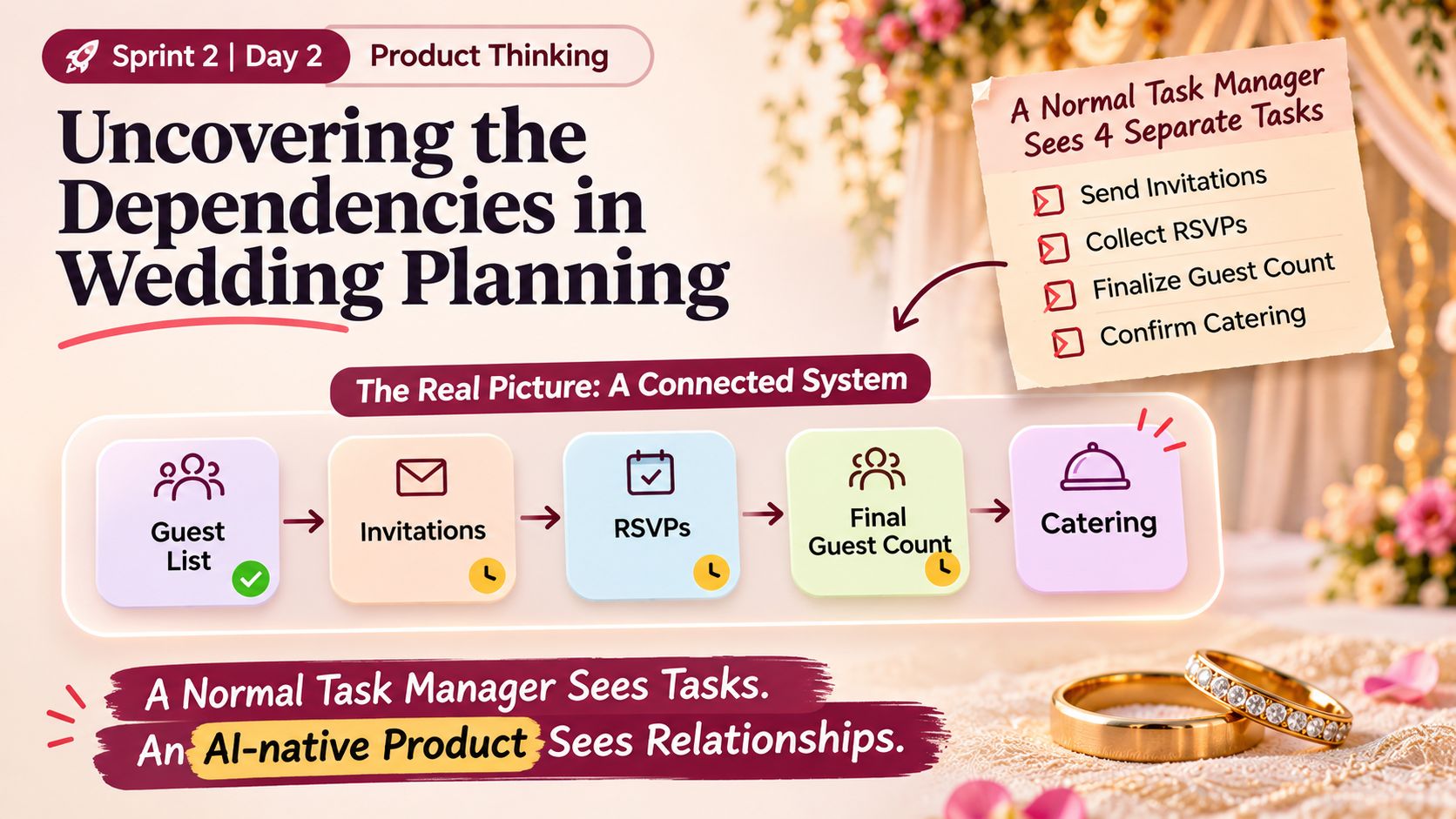
Sprint 2 | Day 2 - Product Thinking Yesterday, I explored why wedding planning is more than a checklist problem. Today, I mapped the hidden dependencies behind it. For example: Guest List → Invitations → RSVP → Final Guest Count → Catering At first glance, these look like five separate tasks, but they aren't. If the guest list changes, invitations may need to change. If invitations are delayed, RSVPs are delayed. If RSVPs are delayed, the final guest count is uncertain. And that can directly impact catering. That led me to an important product insight: A normal task manager sees tasks. An AI-native product sees relationships between tasks. This changes how the product should work. Instead of simply asking: “What tasks are pending?” The product should be able to answer: “What is affected if this task gets delayed?” and “What should I do next?” That dependency layer is becoming the foundation of the AI Wedding Planning Orchestrator I'm building for Sprint 2 of Product Space. Tomorrow → turning this product thinking into the actual prototype. #AI #AIPM #ProductManagement #ProductThinking #AIProduct #GenAI #ProductDiscovery #ProductSpace #GrowInCommunityAkshay kumar @akshay · Nov 17
A Large Language Model (LLM) is trained to predict the next token - a piece of a word or a word - based on the context it has seen. It repeats this prediction, token by token, until it generates a complete response. That’s a big reason LLMs can produce remarkably fluent answers. But here’s the important part for Product Managers: Fluency ≠ Accuracy. What this means when you're building AI products: Outputs are probabilistic. The same input can produce different answers, so we need to design for variation rather than assuming one fixed output. → Confidence can hide incorrect answers. An LLM can generate something that sounds convincing even when it's wrong. → The model's response depends on its available context. That can include its training, system instructions, user input, retrieved knowledge, and tool/API results. → AI features need evaluation and guardrails. A good prompt alone isn't a product strategy. So before adding AI to a feature, I now ask 3 questions: 1️⃣ Is some variation in the output OK here, or could it be harmful? 2️⃣ What happens when the answer is wrong, and how will the user notice? 3️⃣ Would deterministic code or a traditional solution do this job better? For example: Calculating a refund amount → Use code. Writing the apology email for that refund → Use AI. The first requires deterministic accuracy. The second benefits from variation, tone, and natural language. My takeaway: Use AI where variation is a feature: → Drafting → Summarising → Brainstorming → Personalisation → Natural-language interaction Be careful where variation can become a bug: → Mathematics → Payments → Financial calculations → Compliance → Critical decisions As PMs, the question isn't: “Where can we add AI?” It's: “Where does AI create better user value than a deterministic solution - and how do we manage the risk?” Where have you seen an AI product give a confident but wrong answer? #AIProductManagement #AIPM #GenerativeAI #LLM #GrowInCommunity